
Fahrenheit vs. Celsius
Zero is wherever you put it.

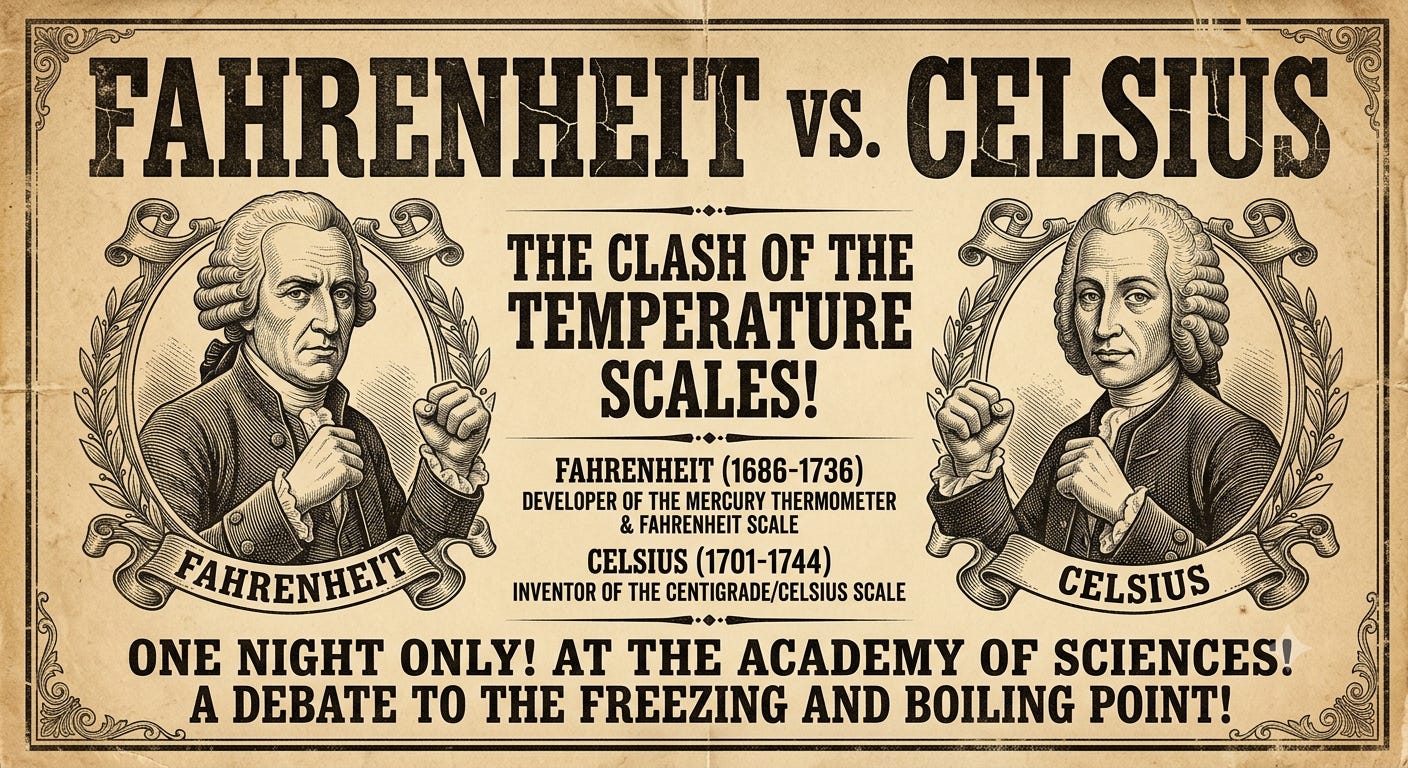
The successive heat waves in Europe and the United States, along with so many people from around the world visiting for the World Cup, have me thinking about temperature, how we measure it—Celsius in Europe and most of the rest of the world, Fahrenheit in the United States—and which system makes more sense. The answer, if there is one, lies in how the two systems came to be.
An instrument maker designing a measuring device faces at least three questions: what’s the least amount I want to measure, what’s the most, and what do I want to mark in between. That is, the maker needs to decide the limits of the scale and its gradations. For some instruments, the answers to these questions are easy. A speedometer, for example, measures a car’s speed. At the bottom of the scale is zero speed: the car is stopped. At the top is the maximum speed the car can achieve (or maybe a little more if the marketing team wants to make the driver feel empowered). In between, the scale ticks off miles or kilometers per hour, which are standard units of velocity set at low enough resolution to be easy to track.
Other instruments are not so clear-cut. The earliest instrument makers were rarely working with standardized units of measurement. The British “stone,” for instance, varied for centuries not only from town to town but from commodity to commodity. A stone of wool weighed something different from a stone of beef until Parliament finally fixed it at fourteen pounds. Problems like these, though, are mostly problems of agreement. A stone weighs whatever we all say it weighs. Consensus, or an act of Parliament, can settle the matter.
A more intractable problem arises when an instrument maker doesn’t know what the top and bottom are. That was the case with temperature in the 17th and 18th centuries. How do you know what the least amount of heat is? What is the coldest thing that needs to be measured? What is the hottest? And if you don’t know the answers to those questions, how can you possibly decide where the marks between them go?
One of the first people to face this problem systematically was Fahrenheit. Daniel Gabriel Fahrenheit (1686–1736) was born in Danzig (now Gdańsk) on the Baltic coast and spent most of his working life in the Dutch Republic as a glassblower and maker of scientific instruments. His mercury thermometers were the first reliable, reproducible instruments of their kind. Fahrenheit’s answer was to base the top and bottom of his scale on human experience. He set the bottom at the coldest temperature he could achieve in the laboratory by mixing a slurry of ice water with an assortment of salts, which chemically lowered the temperature of the mix (roughly, the story goes, to match the coldest days of Northern Europe’s brutal winter of 1708–09). He marked his thermometer at zero where it sat when placed in this icy mix. For the top of the scale he used the body temperature of a healthy human, which he marked at 96 (later recalibrations nudged it up to the familiar 98.6). Ninety-six also answered the instrument maker’s third question, the one about the marks in between: it put 64 degrees between freezing water at 32 and the heat of the human body, a span that could be laid out on a tube simply by bisecting the interval six times over.
A few decades later, a Swedish scientist named Celsius took a different approach. Anders Celsius (1701–1744) was a professor of astronomy at Uppsala University who had traveled with a French expedition to Lapland to measure the shape of the Earth. Instead of taking human experience to set his standard, he took the phase-change properties of water, setting 0 at water’s freezing point and 100 at its boiling point. Or rather, he did the reverse. Celsius’s original scale ran upside down, with 0 at boiling and 100 at freezing, and was flipped into its familiar form only after his death.
Making sense
So which makes more sense? Both have virtues. Partisans of Celsius say it’s more modern and better for scientific purposes, fitting better into the overall metric worldview. It’s easier to do math on a hundred-point scale that bears a direct correspondence to natural phenomena. From this perspective, Fahrenheit is archaic. Why is freezing 32?
Partisans of Fahrenheit say it’s more useful for talking about the weather because it more closely matches lived experience. In most of the populated world (Minnesotans and Siberians may beg to differ) zero degrees Fahrenheit is about the coldest weather a person normally endures. Zero Celsius isn’t really so bad. One hundred degrees Fahrenheit—right around the body heat Fahrenheit set at the top of his scale—is the hottest of summer days (or at least it was until recently). At 100 degrees Celsius, you’re dead. The difference between 50 and 60 degrees Fahrenheit is the difference between bringing a jacket or not. In Celsius that translates to 10 and about 15 degrees, which gives you about half as much information to go on.
History, for what it’s worth, has mostly sided with Celsius. Fahrenheit, carried abroad by the British Empire, was the Anglophone standard for two centuries. Celsius spread with the metric system after the French Revolution. When Britain and its former colonies went metric in the 1960s and 70s, Fahrenheit survived in everyday use almost nowhere but the United States.
But ultimately both are conventional, the product of two men drawing lines on tubes at different temperatures of their choosing and deciding on how many equal tick marks to put between them. Even the direction of the scale, it turns out, was a matter of convention. Neither one is essential. The difference between them is not one of accuracy but of philosophy. Fahrenheit took the measure of the world from human experience; Celsius took it from the behavior of water. Temperature is natural. Our systems for measuring it are all man made.
Interesting read! I never knew that the original top of the Fahrenheit scale coincided with body temperature. Personally, I prefer the Fahrenheit we still use in the USA-its degrees are more precise than those of the Celsius scale.